Key Takeaways
- Most contact center cost per contact numbers understate reality because they ignore QA, technology, supervision, and rework.
- Sample based QA creates hidden cost and risk that only show up in escalations, callbacks, and churn, not in the headline metric.
- Treating AI QA and AI insights as explicit line items in the model helps leaders see where full coverage improves economics, not just quality.
- A fully loaded cost per contact framework that includes labor, QA, technology, supervision, and error cost leads to better decisions about offshoring and outsourcing.
- Pilots that combine Philippine based teams, accent neutralization, and AI QA on 100 percent of calls can clarify the true economics without large upfront commitments.
Article At A Glance
Contact center and HelpDesk leaders are under pressure to cut costs while protecting customer experience, yet many rely on cost per contact numbers that leave out major expenses and risks. The metric looks clean, but it often hides QA sampling, fragmented technology, supervision time, and the cost of fixing errors. The result is a misleading picture of what it really costs to serve customers and where offshoring or AI investments pay off.
A modern cost per contact model has to capture the full system: people, processes, QA coverage, technology stack, and governance. It also has to connect cost directly to outcomes such as CAST, conversion, accuracy, and first contact resolution. When you add AI QA and insights to 100 percent of calls, the economics shift, but only if you account for those changes explicitly instead of treating AI as a free add on.
This article introduces a practical, leadership ready framework for measuring fully loaded cost per contact in environments that use AI QA and AI insights. It shows where traditional models break down, what a better model looks like, and how regional utilities, healthcare SMBs, and telecom resellers can use pilots to validate the numbers before committing to long term outsourcing.
Your Cost Per Contact Number Is Probably Wrong
Why Leaders Rely On Thin Cost Models
Most internal cost per contact figures start with agent wages or salaries and divide by contacts handled. That is a useful first step, but it leaves out several categories that materially change the economics:
- QA analysts and supervisors who review calls.
- Technology platforms for telephony, CRM, QA, and AI.
- Manager and leadership time spent coaching, reporting, and firefighting.
- Rework when issues are not resolved the first time.
When those costs sit in separate budgets, it is easy to compare an internal contact center to an offshore model based only on hourly rates. Leaders then worry that offshoring will damage customer experience without realizing that their current cost per contact already includes hidden quality and risk overhead.
The Risk Of Understated Costs
Understated cost per contact numbers create several problems:
- Finance teams underestimate the true cost of “keeping things as they are.”
- Operations leaders struggle to justify investment in QA or technology because it looks like pure overhead.
- Vendor comparisons focus on headline price instead of fully loaded economics and quality outcomes.
For SMBs with 10–100 agents, these blind spots make it harder to see when AI QA, offshoring, or outsourcing can help lower cost per contact while maintaining or improving CAST, conversion, and accuracy.
Why Cost Per Contact Gets Murky Fast
Sample Based QA Hides The Real Cost Of Errors
Traditional QA reviews a small fraction of calls or tickets. Analysts listen, score, and document issues, then provide coaching. The rest of the interactions go unreviewed. On paper, QA costs look modest. In practice, limited coverage allows error patterns to persist:
- Agents repeat the same mistakes without feedback.
- Misunderstandings and script deviations go unnoticed.
- Small issues compound into callbacks, escalations, and churn.
Those downstream impacts increase effective cost per contact, but they rarely show up in the core metric. Leaders see a stable number while the business quietly pays for repeated rework and brand damage.
Technology Costs Get Buried Or Ignored
Most contact centers run on a stack of tools:
- Telephony and call routing.
- CRM or ticketing systems.
- QA platforms and scorecards.
- AI tools for transcription, analytics, or quality assurance.
These costs appear in IT or shared services budgets, not in the cost per contact calculation. When leaders consider adding AI QA or AI insights, they often see only the incremental subscription cost, not the total stack and the savings that full coverage QA can unlock.
Ignoring technology in the cost model creates two distortions:
- It makes internal operations look cheaper than they are.
- It makes AI enabled outsourcing look more expensive than it is, because AI is seen as an add on rather than a replacement for manual QA and supervision effort.
Supervision Time Is Rarely Counted
Team leads and supervisors spend a significant portion of their week:
- Reviewing calls and tickets.
- Coaching and performance conversations.
- Managing schedules, escalations, and quality issues.
- Preparing reports for operations, finance, and CX leadership.
That time represents cost per contact. When it is treated as general management overhead instead of a specific component of customer contact economics, leaders undervalue process improvements and AI tools that reduce supervision load. It also makes vendor management look more burdensome than it may be in a well designed outsourcing system.
What A Clean Cost Per Contact Model Actually Looks Like
Fully Loaded Offshore Rates Versus Fully Loaded Internal Rates
A clean model starts by putting internal and offshore economics on equal footing. For internal teams, this means including:
- Agent wages or salaries.
- Benefits, taxes, and employment obligations.
- Facilities, equipment, and connectivity.
- QA analysts and supervisors.
- Technology stack costs allocated per contact.
- Rework and escalation costs tied to quality issues.
For offshore teams, it means recognizing that a single fully loaded rate already includes wages, benefits, taxes, facilities, and basic tools. Leaders still need to layer in:
- AI QA and AI insights coverage.
- Accent neutralization technology.
- Reporting and dashboards that make performance visible.
Only when both sides reflect fully loaded cost does the comparison become meaningful. An offshore rate that appears higher than bare internal wages can still represent lower true cost per contact once QA, technology, and supervision are integrated into the view.
AI QA Coverage As A Line Item, Not A Bonus Feature
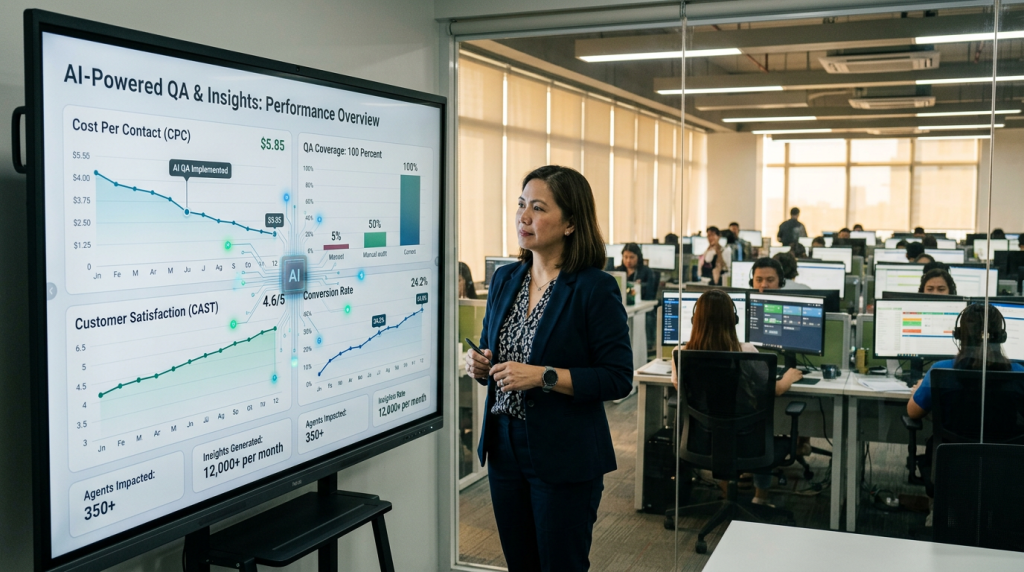
AI QA that covers 100 percent of calls changes the economics of quality and coaching. It:
- Reduces reliance on large human QA teams.
- Surfaces patterns quickly, allowing targeted coaching.
- Provides consistent scoring and insight across all interactions.
If AI QA is treated as a bonus feature or marketing promise instead of a line item in the cost model, leaders miss the opportunity to reallocate budgets from manual QA sampling to automated, full coverage oversight. They also fail to see how AI QA can reduce rework and error costs, which are often substantial.
Reporting That Ties Cost To Outcomes Like CAST And Conversion
A clean model does more than tally inputs. It connects cost per contact to outcomes such as:
- CAST and conversion rates.
- Accuracy and first contact resolution.
- Customer satisfaction and complaint volume.
That connection helps leaders understand whether a higher cost per contact is justified by better outcomes or whether a lower cost is hiding unresolved problems. AI insights that report on CAST, conversion, and accuracy across 100 percent of calls make this link easier to see and act on.
Example Cost Components Table
A simple table can clarify what belongs in a fully loaded cost per contact model:
| Component | Internal Team Included | Offshore Team Included |
| Agent wages and salaries | Yes | Yes |
| Benefits and employment | Yes | Included in rate |
| Facilities and equipment | Yes | Included in rate |
| Manual QA staff | Yes | Lower, supplemented by AI QA |
| AI QA and insights | Optional | Core design element |
| Accent neutralization tools | Rare | Core design element |
| Supervisors and team leads | Yes | Shared with partner |
| Reporting and dashboards | Limited, tool specific | Integrated with outsourcing model |
This view helps leaders see where AI QA and AI insights sit, and how they change the mix of human and technology costs.
The Fully Loaded Cost Per Contact Diagnostic Framework
To move from abstract discussion to action, leaders need a diagnostic framework. The following elements can be quantified separately and then combined into a view of fully loaded cost per contact.
Direct Labor Cost Per Contact
This is the most familiar part of the model:
- Total agent labor cost, including wages, benefits, and employment obligations.
- Divided by the number of contacts handled across phone, chat, email, or other channels.
When leaders have clear occupancy, schedule efficiency, and volume data, this number is straightforward. The framework encourages them to treat it as one piece of the puzzle, not the entire picture.
QA Coverage Cost Per Contact
QA coverage cost includes:
- Human QA staff salaries and benefits.
- Time supervisors spend reviewing calls or tickets.
- AI QA platform costs, if in use.
To calculate QA cost per contact, leaders can:
- Determine total QA related spending for a period.
- Divide by the number of contacts in that period.
- Compare this for human only QA sampling, AI assisted QA, and AI first models.
This reveals how coverage levels and tools affect both cost and quality visibility.
Technology And AI Cost Allocation Per Contact
Technology allocation should account for:
- Telephony and routing systems.
- CRM or ticketing platforms.
- AI transcription and analytics.
- QA platforms and scorecard tools.
Leaders can calculate per contact technology cost by:
- Summing relevant platform and license fees.
- Allocating shared costs based on contact center usage.
- Dividing by total contacts for the period.
This makes AI QA and AI insights visible in the cost per contact calculation rather than hidden in general IT spend.
Supervision And Management Time Per Contact
Supervision cost includes:
- Team leaders and supervisors focused on contact center operations.
- Operations managers who spend significant time on QA, coaching, and escalations.
- Time spent on reporting and governance meetings.
Leaders can estimate per contact supervision cost by:
- Assessing total supervision hours spent on contact center functions.
- Converting those hours to cost based on compensation.
- Dividing by total contacts handled in the same period.
This clarifies how changes in QA models, process design, and outsourcing structures affect management load.
Reporting And Insights Value Per Contact
Reporting cost and value are harder to quantify, but they matter. Leaders can:
- Identify tools and resources used to produce meaningful reports on CAST, conversion, and accuracy.
- Estimate time spent by analysts and managers interpreting data.
- Relate those investments to decisions that reduce future cost per contact, such as improved scripts or SOPs.
Rather than pursuing intensive reporting without clear impact, this element encourages leaders to focus on insight streams that directly inform coaching, process changes, and vendor management.
Rework And Error Cost Per Contact
Rework and error cost is often the largest hidden component. It includes:
- Second contacts for the same issue.
- Escalations to senior staff or specialist teams.
- Corrections to billing, account setup, or service changes.
- Time spent handling complaints tied to poor resolution.
Leaders can approximate this by:
- Tracking repeat contact rates for key issue types.
- Estimating the additional handling time and resource cost per repeat.
- Assigning an average cost per repeat and dividing by total contacts.
When AI QA and insights highlight patterns that reduce those repeats, the impact on cost per contact becomes clear.
Summary Framework Table
The full diagnostic framework can be summarized as:
| Element | Purpose |
| Direct labor cost per contact | Baseline agent cost to handle interactions |
| QA coverage cost per contact | Cost of quality oversight and coaching |
| Technology and AI allocation per contact | Cost of platforms and AI tools |
| Supervision and management per contact | Leadership time and governance overhead |
| Reporting and insights value per contact | Investment in decision quality |
| Rework and error cost per contact | Cost of poor resolution and repeat work |
This table can be used as a checklist when building or revising internal cost models and when evaluating outsourcing proposals.
What This Looks Like In Practice
Scenario 1: Regional Utility With A 12 Person Internal Contact Center
A regional utility runs a 12 person internal contact center that handles billing questions, service issues, and outage calls. Finance tracks agent salaries and benefits, plus basic telephony costs, and reports a cost per contact that looks reasonable. QA reviews around 5 percent of calls, supervisors spend evenings catching up on coaching, and customers sometimes call back to fix misunderstandings.
When leadership applies the diagnostic framework, they find:
- QA and supervision costs per contact are higher than expected.
- Repeat contacts for billing corrections drive significant rework.
- Reporting is limited, so patterns behind repeat calls are unclear.
The utility considers a pilot with a Philippine based Customer Experience Center that includes accent neutralization and AI QA on 100 percent of calls. They focus the pilot on a subset of billing calls with simple, black and white processes. During the pilot, they measure:
- New fully loaded cost per contact for pilot work.
- Changes in repeat contact rates and accuracy.
- Impact on supervisor time and coaching.
The results show that, for the pilot scope, fully loaded cost per contact can be lower with offshore teams using AI QA and insights, even after including the new tools and vendor management time. This data gives leaders confidence to expand gradually with clear boundaries.
Scenario 2: Healthcare SMB Running Sample Based QA On A Small Percentage Of Calls
A healthcare SMB handles appointment scheduling and basic non clinical inquiries through an internal contact center. Compliance and privacy concerns make the team cautious about offshoring. QA reviews 8 percent of calls, and compliance incidents are rare but serious when they occur. Cost per contact focuses on internal wages and telephony.
Using the framework, the leadership team sees:
- QA sampling leaves many interactions unreviewed.
- Rework and complaint handling for scheduling mistakes and miscommunication create hidden labor costs.
- Supervisors invest significant time in call review without clear patterns.
When they explore AI QA, they structure the conversation around:
- Which call types can safely be reviewed by AI tools with appropriate data boundaries.
- How AI QA can flag potential compliance risks across 100 percent of eligible calls.
- How offshore teams could handle specific non clinical work if processes are kept simple and clear.
In a pilot, they limit offshoring to a subset of non sensitive calls, use AI QA for pattern detection, and involve internal legal and IT stakeholders to define data flows and boundaries. Over the pilot period, they measure changes in:
- Fully loaded cost per contact for the pilot scope.
- Repeat contact rates for scheduling issues.
- Supervisor time dedicated to QA.
The data shows that when work is carefully scoped and AI QA is designed to support oversight, the organization can reduce cost per contact for selected tasks while maintaining appropriate compliance guardrails.
Scenario 3: Telecom Reseller That Added AI QA Without Changing Its Cost Model
A telecom reseller implemented AI QA to score calls and provide insights but did not adjust its cost per contact model. Finance continued to report numbers based on agent wages and legacy QA headcount. Supervisors used AI reports sporadically, and the organization struggled to articulate the financial impact of the new tools.
After revisiting the cost model with the diagnostic framework, leaders:
- Reallocated part of QA headcount to higher value work, reducing manual sampling.
- Quantified AI QA platform cost per contact.
- Measured changes in repeat contact rates and conversion for specific campaigns.
This revealed that AI QA, when integrated into the cost model and coaching practices, allowed the reseller to lower effective cost per contact and improve conversion for targeted call types. The organization then explored offshore support for simpler customer interactions, using the updated model to evaluate fully loaded economics and manage risk.
Frequently Asked Questions
Does Adding AI QA Always Reduce Cost Per Contact?
Adding AI QA is designed to reduce effective cost per contact when:
- QA coverage increases meaningfully without proportional headcount growth.
- Insights are used to adjust scripts, SOPs, and coaching.
- Repeat contact and error rates decline.
If AI QA is added without changes to supervision practices or process design, it may increase technology costs without a corresponding reduction in rework or management time. The diagnostic framework helps leaders assess whether the conditions for savings are present.
How Do I Calculate The Fully Loaded Cost Of My Current Internal Team?
Leaders can build a baseline model by:
- Summing agent wages, benefits, and employment obligations.
- Adding QA staff and supervisor compensation tied to contact center work.
- Including facilities, telephony, CRM, and any QA or AI tools.
- Estimating rework and error costs based on repeat contact rates.
- Dividing the total by contacts handled in the same period.
This baseline can then be compared to potential outsourcing or AI enabled models using the same structure.
What Does AI QA On 100 Percent Of Calls Actually Cost Per Month?
AI QA costs depend on:
- Volume of calls or transcripts processed.
- Features such as scoring, transcription, sentiment analysis, and custom models.
- Integration needs with existing telephony or CRM platforms.
Leaders should request pricing aligned to their specific volumes and use cases, then convert it to cost per contact by dividing monthly platform cost by the number of interactions. Comparing this figure to human QA costs and error related rework helps clarify the economics.
Can Offshore Teams In The Philippines Realistically Handle Complex Customer Interactions?
Offshore teams can handle complex interactions when:
- Processes and scripts are simple, black and white, and well documented.
- Boundaries are clear about which tasks must remain with licensed professionals or internal staff.
- Accent neutralization and training address communication standards.
- AI QA provides oversight and pattern detection across 100 percent of calls.
Work that requires real time judgment without clear guidelines or that crosses into licensed professional territory should remain in house. Offshore teams perform best on repeatable, rules based tasks within clear compliance and process frameworks.
How Long Does It Take To Get Accurate Cost Per Contact Data After Switching To An Outsourced Model?
Cost per contact data typically stabilizes once:
- Volumes reach steady operating levels after transition.
- Processes and SOPs are fully documented and adopted.
- QA and reporting cadences are established.
For many SMBs, a 30 day pilot provides directional insight into cost and quality patterns, while a longer period, such as 90 days, gives more reliable baselines for fully loaded cost per contact comparisons.
How Should Finance, CX, And Operations Collaborate On The Cost Model?
A robust cost model usually requires:
- Finance to provide guidance on cost allocation and budgeting.
- CX leaders to specify quality metrics and customer experience targets.
- Operations leaders to detail workflows, process complexity, and supervision needs.
Joint working sessions that walk through each element of the diagnostic framework help align assumptions and ensure that cost per contact figures reflect shared realities rather than siloed views.
What Metrics Beyond Cost Per Contact Should Sit Next To This Model?
Cost per contact should be assessed alongside:
- CAST and conversion rates.
- CSAT and complaint volumes.
- First contact resolution and accuracy.
- Repeat contact rates and escalation patterns.
When cost is viewed together with these metrics, leaders can see whether changes in QA, AI tools, or offshoring arrangements are improving the overall system rather than simply lowering a number.
Rethinking Contact Center Economics
For SMBs with meaningful contact volumes, cost per contact is not just a finance metric. It is a lens on the entire system: how work is routed, how quality is managed, how technology is used, and how leadership time is spent. When AI QA and AI insights are added to 100 percent of calls, that lens can become sharper, but only if the model reflects the new reality.
It is responsible to start by assessing your current economics using the diagnostic framework, then test assumptions through a pilot rather than committing to a full transition based on rough numbers. A structured pilot with clear SOPs, defined call types, and agreed metrics allows you to see how fully loaded cost per contact changes when offshore teams, AI QA, and accent neutralization are integrated into your operation.
If you want to explore what this might look like for your own contact center or HelpDesk, a compatibility conversation is a practical next step. You can map your current cost drivers, QA practices, and reporting gaps, then discuss how an outsourcing model with Philippine based teams and AI QA on 100 percent of calls is designed to support a more accurate, compliance aware view of cost per contact and overall performance. From there, you can shape a pilot or process readiness review that respects your risk boundaries and focuses on the parts of your customer experience where an integrated system is most likely to improve both cost and outcomes.
Any claims in this article are based on previous experiences with clients and differ from client to client. Optimize CEC cannot make a guarantee on results because they depend on factors including internal processes, organizational readiness, and execution quality.